Read the cloth.
Meet the context.
The official Manual introduces Tujia brocade as Xilankapu and places it within a wider cultural landscape. This page keeps the textile at the centre while treating any visit as something to verify, not stage on demand.
 OFFICIAL TOUR GUIDE MANUAL · PDF PAGE 54
A textile is evidence.
Not decoration.
The Manual describes two main product forms: patterned quilt covers, called Xilankapu in the Tujia language, and decorative ribbons. It presents Xilankapu as the representative form.
That gives the traveller a more useful starting point than costume alone: look at how the cloth is structured, ask how it was made and keep the maker and setting attached to the object.
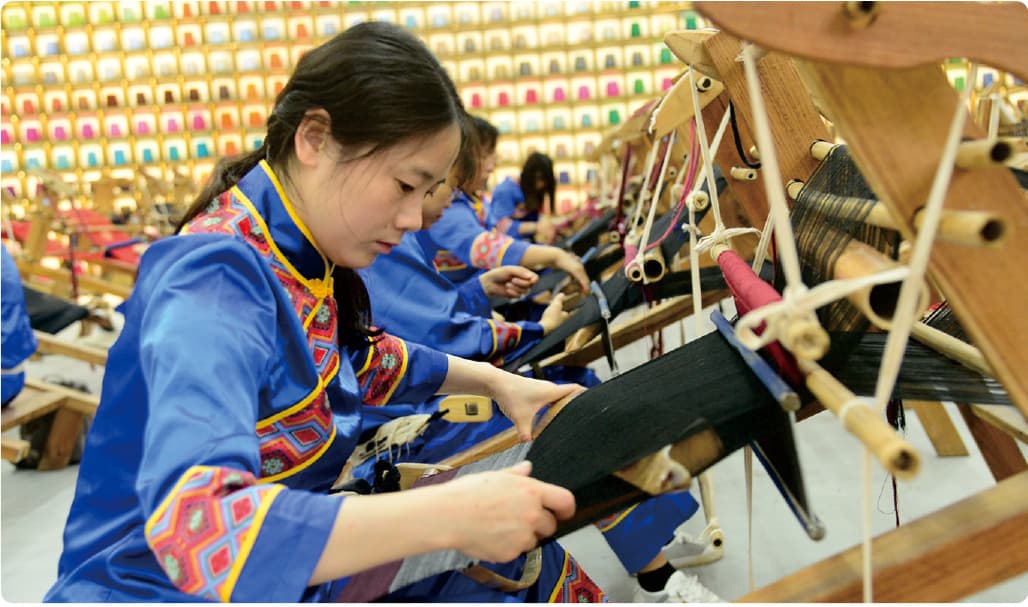
Warp held continuous.
Weft made to move.
The Manual describes an old “continuous warp, discontinuous weft” technique using traditional wooden looms. It also states that the process involves more than 12 steps and that more than 400 patterns have been created.
- Structure
- Continuous warp, discontinuous weft
- Published process
- More than 12 procedures
- Published repertoire
- More than 400 patterns
Structure first.
Motif second.
This diagram explains the relationship between warp and discontinuous colour fields. It is not a reproduction of a named Xilankapu pattern and assigns no symbolic meaning.
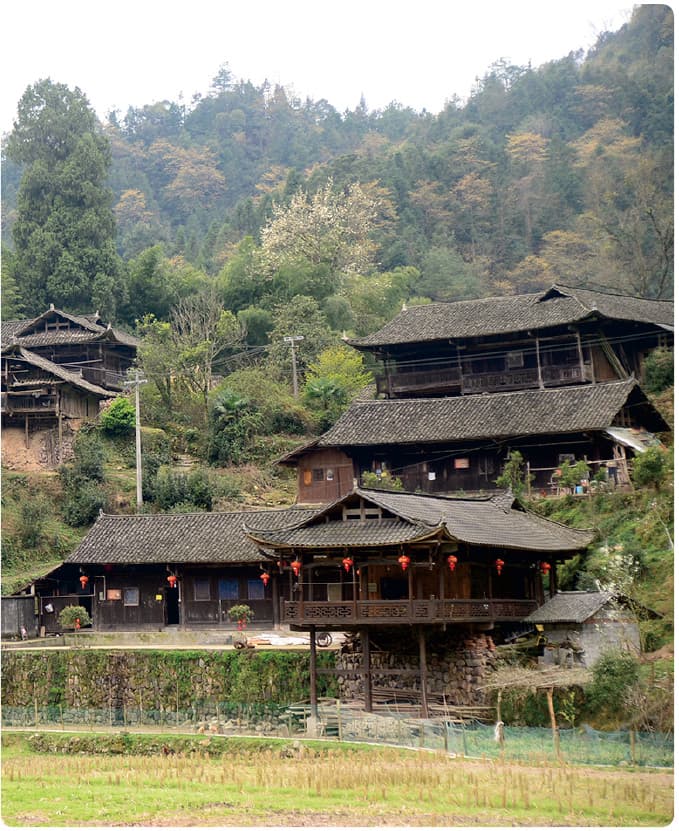
Cloth does not stand alone.
The Manual places brocade beside stilted houses, hand dance, Maogusi dance and Tima chant within a wider account of regional cultural heritage. Those are distinct forms and contexts; one should not be used as shorthand for all the others.
A considered visit therefore keeps material, maker, setting and interpretation together. It does not promise a private home, present a staged costume as everyday life or treat a shop display as complete cultural evidence.
Protect the context
before the visit.
- 01
Appropriate venue
Confirm a currently operating venue that can interpret the material respectfully in English.
- 02
Artisan or interpreter
Verify who will explain the craft and whether a demonstration is genuinely available that day.
- 03
Visit format
Distinguish an exhibition, workshop, shop and community setting before the route is proposed.
- 04
Provenance
If buying matters, ask who made the piece, what technique is used and what evidence accompanies it.
- 05
Access and pace
Check steps, seating, time on foot and photography rules for the selected venue.
- 06
Wider context
Place the visit beside landscape, food or architecture without compressing culture into a decorative stop.
Keep the evidence.
Verify the encounter.
The Xilankapu name, the two published product forms, described weaving structure, historic framing and documented cultural context.
Venue, artisan or interpreter, demonstration format, language support, opening, access, photography and product provenance.
A private community visit, a guaranteed workshop, stock for purchase, fixed prices or symbolic meaning for a specific pattern.
Say what you want
to understand.
Share your dates, cultural interests, preferred depth, mobility needs and whether making, interpretation or provenance matters most. A local planner can verify an appropriate current format and place it sensibly within the route.
Source: Tour Guide Manual, PDF pages 12 and 54 / printed pages 15–16 and 99–100. Official text and photography adapted under the user-confirmed authorisation. The Manual is publication evidence; the current venue, artisan or interpreter, visit format, language support, access, photography rules, demonstration and product provenance require current confirmation.